Stellate Sturgeon (Acipenser stellatus)

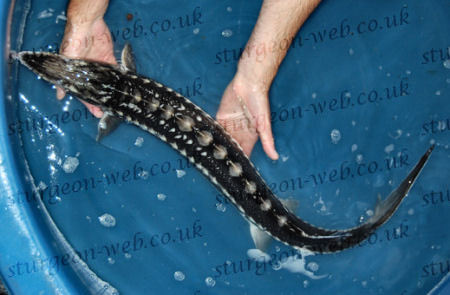
A 100cm Stellate Sturgeon (Acipenser stellatus) 4 years old
The Stellate Sturgeon is also known as Stellatus or the Starry Sturgeon. Once very rare, there are a number of breeders now. The Stellatus is a must for the sturgeon collector.![[This work is copyright © 2000-2024 www.sturgeon-web.co.uk]](img/copyright.gif)
This species does not tolerate low oxygen levels so extra oxygenation in the summer months is essential. Sturgeons do not tolerate strong treatments such as formalin.
The Stellate Sturgeon is more likely to jump out of the pond than other sturgeon species so make sure there is a net or barrier.
Description
Acipenser stellatus has 9-16 dorsal scutes, 26-43 lateral scutes, 9-14 ventral scutes, 40-54 dorsal fin rays and 22-35 anal fin rays.
Acipenser stellatus is very easy to recognise, as the nose/head is up to a 25% of the total length of the fish. With bluish to black skin and a white-cream ventral (underside) and very pronounced scutes (the bony plates on the skin) that are a yellowish-white colour. Better looking than Diamond sturgeon, and keeps its colour when older, unlike a lot of Diamond Sturgeons.
Acipenser Stellatus can grow to a maximum size of 2.2m and 70kg in the wild but in a large pond 1.3 - 1.5m and 10 - 15kg is the more usual size.
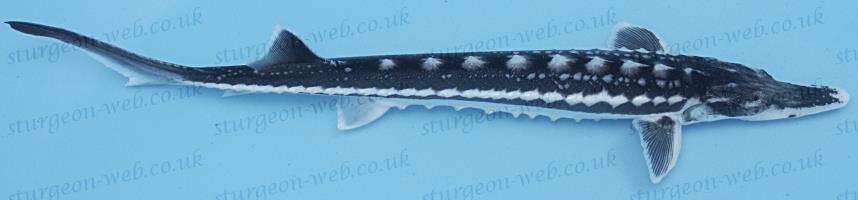
This 60cm Stellate Sturgeon (Acipenser stellatus) is 2 years old.
Recommended Pond Size
The Stellate Sturgeon is a more slender fish than the Diamond Sturgeon (Acipenser gueldenstaedtii) and can be kept in a smaller pond. It is a very keen swimmer though, never really stopping, so it needs plenty of space to swim. A big pond with good current will keep this fish feeding and in good health. A pond of 3,000 - 6,000 gallons (13,500 - 27,000 litres) is recommended if you want to keep a Stellatus into maturity.
Food & Feeding
One of our Stellate Sturgeons (Acipenser stellatus)
Sturgeons DO NOT, as some people would have you believe, eat banket weed or 'clean the bottom of the pond'. Sturgeons need to be fed all year round, they need 2-3% of their body weight of good quality food per day in the summer, less in the winter.
A healthy sturgeon diet must contain a high level of animal protein, sturgeons need a minimum protein content of 40% and an oil level of 15% or more. A a small percentage of the protein can be obtained from soya but the majority needs to be from fishmeal or other animal sources.
Pellet to Sturgeon size:
- 2mm pellet Starter Diet Sturgeon 10-20cm (4-8in)
- 3mm pellet Sturgeon 20-36cm (8-14in)
- 4.5mm pellet - sturgeon size 30-50cm (12-20in)
- 6mm pellet Sturgeon 36-61cm (14-24in)
- 8mm pellet Sturgeon over 61cm (24in)
Stellatus (Acipenser stellatus) and Sterlets (Acipenser ruthenus) have smaller throats; use a size smaller for them.
Buy sturgeon food pellets from Orchard Fisheries »
For more information feeding your sturgeon see our Sturgeon Food and Feeding page.
Health Issues
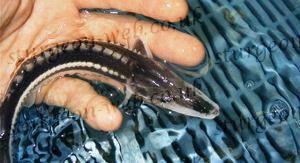
A 25cm Stellate Sturgeon (Acipenser stellatus)
The most common sturgeon health problems are food and/or oxygen related, get these two vital things right and your sturgeons should remain fit and healthy.
Use an oxygen test kit to make sure there is enough oxygen in the water. Follow the instructions that come with the kit to ensure correct results. Do not assume that there is plenty of air just because you have an air pump running. Many things can affect the amount of dissolved oxygen in the water so testing is the only way to be certain. Warm water holds less oxygen than cold water so be vigilant during hot weather, especially stormy nights when the oxygen may drop to dangerously low levels suddenly.
Feed your sturgeon plenty of the correct food all year round. For more information about feeding your sturgeon see our Sturgeon Food and Feeding page.
Avoid strong chemical treatments such as formalin/formaldehyde, Potassium permanganate, Copper sulphate or any treatment that states not to be used with Golden Orfe (Leciscus sp.) or Rudd (Scardinius reythrophathalmus), these will probably kill your sturgeon. Salt is the safest treatment to use with sturgeons. For more information about treating your sturgeon see our Medications and Treating Sturgeons page.
Provide the best possible water quaility for you fish. Run the pump and filtration all year round and keep a spare back up pump in case of main pump failure. For more information about water quality see our Water Quality page.
Wild distrubution
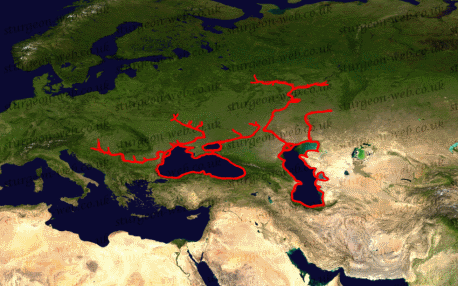
Stellate Sturgeon (Acipenser stellatus) wild distrubution map
The Stellate Sturgeon is found in mainland eastern Europe and western Asia, inhabiting the Caspian Sea, Black Sea and Azov Sea. The species is occasionally found in the Aegan Sea.
The main spawing grounds are in the Volga River, Ural River, Terek River, Sulak River, Kura River, Don River, Kuban River and the Danube River. The largest population is found in the Caspian Sea.
The Stellate Sturgeon is listed as 'Critically Endangered' on the IUCN Red List of Threatened Species.
Taxonomy
Kingdom: Animalia
Phylum: Chordata
Subphylum: Vertebrata
Superclass: Osteichthyes
Class: Actinopterygii
Subclass: Chondrostei
Order: Acipenseriformes
Suborder: Acipenseroidei
Family: Acipenseridae
Subamily: Acipenserinae
Genus: Acipenser
Species: Acipenser stellatus Pallas, 1771
Common names
Sevruga, Star Sturgeon, Starry Sturgeon, Stellate Sturgeon, Stellatus
Links
Encyclopedia of Life | FAO Species Fact Sheet | Fishbase | ITIS | World Register of Marine Species
Written by Terry White & Graham Quick
Contents
Home
Sturgeon Species
Sturgeon Care
Sturgeon Health
Water Quality
Our Other Sites


Copyright © 2000-2024
www.sturgeon-web.co.uk
All Rights Reserved.
Protected by UK Copyright Service Registration No:311386